Edge Reading Writing and Language Level B Interactive Practice
CEFR Levels: What They Are, Why They Matter, and How to Examination Yourself
CEFR levels: what are they? And do they thing?
In the language-learning customs, we often hear other learners throw around certain terms when they're talking about their level in a linguistic communication.
"I speak High german at a B1 level" or "I'grand an A2 in Russian."
But what do B1 and A2 mean?
These descriptors are skill levels in the CEFR system and they're used by language learners to measure their ability in a language.
What are the Unlike CEFR Levels?
The Common European Framework of Reference for Languages, often referred to every bit CEFR or CEFRL, is an international standard for working out your ability within a language. Information technology was established by the Council of Europe and aims to validate linguistic communication power.
The six levels within the CEFR are A1, A2, B1, B2, C1 and C2. With these levels, you tin can easily work out your power in around forty different languages.
The levels are often used casually by language learners to explain their ability at speaking, reading, writing and understanding a language. But there are also exams and certificates available to those who want to make their level official.
Let's start take a look at what the different levels are and what's possible for you at each level.
The "A" Levels: Basic User
A1 | Beginner
At the A1 CEFR level, a language learner can:
- Understand and utilise very basic expressions to satisfy concrete needs.
- Introduce themselves and enquire others questions about personal details.
- Collaborate simply equally long as the other person speaks slowly and conspicuously.
A2 | Elementary
At the A2 CEFR level, a language learner can:
- Understand frequently used expressions in most intermediate areas such as shopping, family, employment, etc.
- Complete tasks that are routine and involve a direct exchange of information.
- Describe matters of immediate need in simple terms.
The "B" Levels: Independent User
B1 | Intermediate
At the B1 CEFR level, a language learner can:
- Understand points regarding family, work, school or leisure-related topics.
- Deal with most travel situations in areas where the language is spoken.
- Create uncomplicated texts on topics of personal interest.
- Depict experiences, events, dreams, and ambitions, as well equally opinions or plans in brief.
B2 | Upper Intermediate
At the B2 CEFR level, a language learner tin can:
- Sympathize the principal ideas of a circuitous text such equally a technical piece related to their field.
- Spontaneously interact without too much strain for either the learner or the native speaker.
- Produce a detailed text on a wide range of subjects.
The "C" Levels: Proficient User
C1 | Advanced
At the C1 CEFR level, a linguistic communication learner tin can:
- Understand a wide range of longer and more demanding texts or conversations.
- Express ideas without too much searching.
- Finer use the language for social, academic or professional situations.
- Create well-structured and detailed texts on complex topics.
C2 | Proficiency
At the C2 CEFR level, a language learner can:
- Understand almost everything read or heard with ease.
- Summarize data from a diverseness of sources into a coherent presentation.
- Limited themselves using precise meaning in complex scenarios.
Here's a video of Benny Lewis, founder of Fluent in 3 Months, explaining the CEFR levels:
When practice the Different CEFR Levels Affair?
The CEFR is frequently used past employers and in academic settings.
You may need a CEFR certificate for:
- School admissions
- University form requirements
- Employment
A CEFR certificate is very handy for your CV or résumé, and they often don't elapse.
That said, many linguistic communication learners use CEFR levels for self-cess so that they can more conspicuously define what they need to work on, and work out what they would like to achieve in their target language.
Aiming for higher CEFR levels are as well a great way to make the transition from an intermediate learner to an advanced learner, and Fluent in three Months founder Benny Lewis has used exams in the by to force himself to amend and refine his linguistic communication skills.
If you're looking for an extra push or for a way to break through a plateau, a language exam could be an constructive mode to do it. Motivation in linguistic communication learning always matters.
When do CEFR Levels not Matter?
Outside of the professional or academic realm, CEFR levels are non equally important. They're really only necessary if you want to ascertain where you lot're at with your target linguistic communication. In a more casual language-learning environment, or when you're only learning languages considering yous bask them, and then CEFR levels are just another tool to aid with your linguistic communication learning.
Sitting an exam requires a lot of written report. If your goal is speaking a linguistic communication, that fourth dimension you lot spend reading, listening and writing to meet the exam requirements volition be time you could have used to improve your speaking skills.
In the by I've done exams for High german, French and Italian every bit well every bit the HSK examination for Mandarin Chinese. In grooming for all these exams, I had to study materials that were completely unrelated to my end goals for the languages.
So, if your language-learning goals do not align with the CEFR scale, and you don't demand a professional qualification, then you can safely ignore it.
How do Yous Piece of work Out Your CEFR Level?
In that location are a few ways you can piece of work out your CEFR level. Many learners opt for self-assessment, using the descriptions I shared to a higher place to judge where they're at.
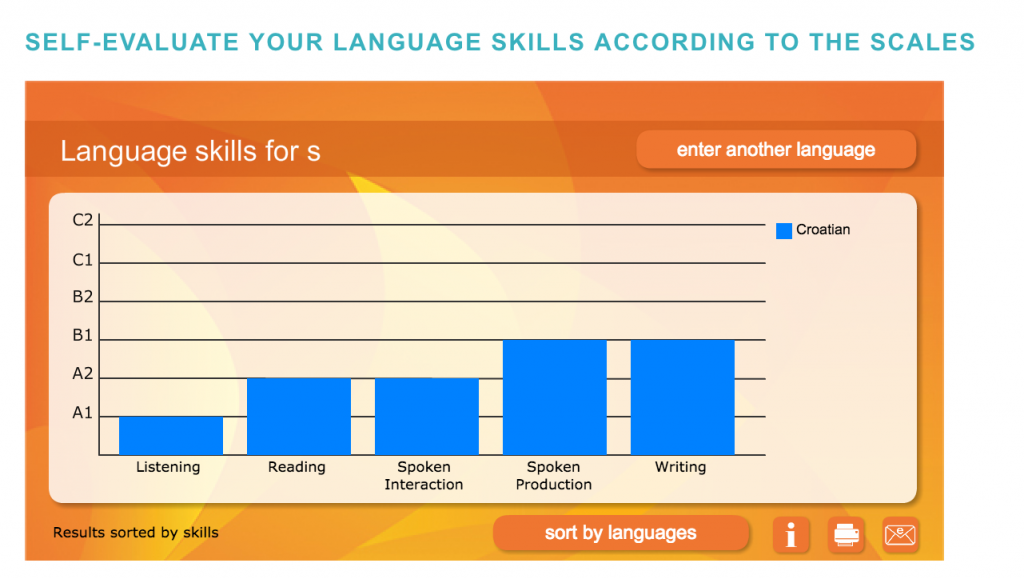
For those looking for something a picayune more formal, you have the option of taking an official examination or a costless online examination.
It's worth noting that CEFR levels embrace a diverseness of skills. A full CEFR exam typically measures skills in listening, reading abilities, speaking, writing, translating and interpreting. That's why some learners segment their abilities, for instance stating that their listening in a linguistic communication is at a B2 level only their speaking is only at a B1 level. Others just average out their abilities and say that they're at a B1 level overall.
CEFR Assessments and Tests Bachelor
Some of your options for official examinations (or for courses with certification) include:
- Alliance Française for French.
- Goethe Institut for German language.
- Teastas Eorpach na Gaeilge for Irish.
- Instituto de Cervantes for Castilian.
- CELI for Italian.
- European Consortium for the Certificate of Attainment in Modern Languages for Bulgarian, Croatian, Czech, English language, French, German, Hebrew, Hungarian, Italian, Smooth, Romanian, Russian, Serbian, Slovak, and Spanish.
- TELC for English, German, Turkish, Castilian, French, Italian, Portuguese, Russian, Polish, and Standard arabic.
- Πιστοποίηση Ελληνομάθειας for Modern Greek.
- Language Testing International for multiple languages.
- Lingoda for Spanish, French, High german, and English.
- ALTE for many other languages.
Online exams include:
- Test English for English.
- Deutsche Welle for German.
- Cambridge English language Linguistic communication Assessment for English language.
- Cambridge Institute for English, Spanish, German, and French.
- Language Level for English Castilian, French, and German language.
- Macmillan Practice Online (paid) for English.
- European Centre for Modern Languages for self-assessment in a diverseness of languages.
Regardless of the exam you lot sit, linguistic communication exams demand intensive study and are a great way to push button your ability in a language to that next level.

Edge Reading Writing and Language Level B Interactive Practice
Source: https://www.fluentin3months.com/cefr-levels/
0 Response to "Edge Reading Writing and Language Level B Interactive Practice"
Post a Comment