Art That Would Have Been Used in a Ritual
The "Total Work of Art"
The notion of a Gesamtkunstwerk (GKW) or "total work of art" was established by aesthetic philosophers and practitioners in the nineteenth century. It represented a grand unification of the arts, encompassing theater, music, trip the light fantastic, and visual design, every bit applied to transcendent literary themes from mythology, folklore, history, and religion. Richard Wagner's music-dramas, almost notably Parsifal, represent a significant manifestation of this philosophy in activeness. The concept of a GKW extended to compages, such that Wagner's operas were to exist performed in a newly synthetic venue that would provide the requisite religious feel of a performance occurring in a shrine, a veritable temple of the arts. This identify, located in the small German town of Bayreuth, was chosen a festival house, reminiscent of the pagan festivals that characterized Germany's ancient by. As with a festival, audience members would engage in a pilgrimage to attend these opera performances. All in all, the GKW would achieve an artful synthesis—or what Smith (2007) calls a "pseudo-organic totality"—that would create a utopian feeling of spiritual purification for those in omnipresence, hailing back to Romanticist aspirations for a life grounded in aesthetics.
This philosophy permeated artistic and architectural do well into the twentieth century and even into modern times. Smith's (2007) historical assay of the Gesamtkunstwerk includes the "full theater" of the Bauhaus movement, the folk glasses and propaganda films of Nazi Deutschland, magical theme parks such equally Disneyland, Andy Warhol's multimedia Happenings, the pseudo-organic totality of the internet with its potential for collaborative networking, and the multimedia immersiveness of virtual reality. As Smith writes, "the total work of art is still a stiff aesthetic thought, always intertwined with technology, continuing to mistiness distinctions betwixt loftier and mass civilisation, artwork and commodity spectacle" (Smith, 2007, p. 6). The total piece of work of fine art is not merely a synthesis of creative media per se, but is often times a form of mass spectacle that engenders total immersion, social collectivity, and even spiritual redemption by those who feel it.
Nosotros will debate in this paper that, long before European aesthetic theorists had devised the notion of a GKW, ceremonial rituals in ethnic cultures had for millennia been syntheses of the arts on a similar calibration and of a similar scope to GKW's. This has been well-described from the perspective of the anthropology of the arts (Durkheim, 1912/1995; Turner, 1966; Schechner, 1974, 1985; Tambiah, 1979; Dissanayake, 1988, 2017; Rappaport, 1999). Our primary thesis hither is that the GKW concept has deep evolutionarily-predisposed and anthropological roots, and that the ethnographic "ceremony-as-Gesamtkunstwerk" is the aboriginal precursor of the more recent practice of "Gesamtkunstwerk-as-ceremony." Our second thesis focuses on religious practice itself, and argues that ceremonial rituals across cultures can be accurately and productively described as collections of arts behaviors and objects. If i performed a thought experiment and eliminated, one by one, each art beliefs or object from any item ceremonial ritual, there would be little that would remain. From this notion, we propose that religious practice and the arts co-evolved, to the point that one system could not have emerged in human societies without the other. We justify this past arguing that the arts function to provide an emotionally-felt and transcendent means of establishing contact with supernatural beings during communal ceremonial rituals.
Before discussing these issues, we first explore an of import cognitive question: how do the arts combine? In other words, if someone had the intention of creating a total work of art, how would they get about doing information technology? For this, nosotros need to retrieve nigh the nature of the arts and how artforms can combine with one another. We volition get-go discuss how to construct a GKW, and then look for historical precedents of the GKW in ceremonial rituals.
How the Arts Combine: A Framework for Synthesizing the Arts
In order to call back almost how to create a synthesis of the arts, we need to consider what the arts are and how they tin can be synthesized. For the purposes of this article, we conceive of the arts in terms of the standard formulation of "branches" found in the humanities, with the four major branches being music, dance, theater1 (and pic, but also including oral forms of storytelling and poesy), and the visual arts, as shown by the tetrad in Figure 1. (Nosotros ignore arts related to the chemical senses, such equally perfumery and gastronomy). We adjacent divide the tetrad into two opposing triangles based on cerebral and behavioral considerations. The summit triangle comprises the "performing arts," and therefore excludes the visual arts equally static objects, such as paintings and sculptures. The bottom triangle comprises what we refer to as the "representational arts," since they tin can be used in a narrative fashion to referentially convey information near objects, people, and events. Music is excluded from this grouping since it is generally unable to convey information referentially in the way that a sentence or picture easily tin. It is non critical for this scheme that all forms of trip the light fantastic toe or visual art be representational. What is important is that these artforms have the potential to be representational and that this is a disquisitional characteristic that distinguishes them from music. Notation that, in the double-triangle representation, theater/film and dance sit down in both categories.
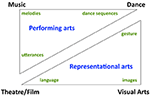
Figure one. A classification of the arts. The figure shows the four major branches of the arts as making upwards a tetrad. Inside that are opposing triangles. The top triangle is fabricated up of the performing arts. These arts are phrase-based, as comprised of verbal utterances (or sentences in written forms), melodies, or dance sequences. The lesser triangle is fabricated up of the representational arts, which comprise a "narrative triad" of spoken language, gesture, and graphic images. Theater/film and trip the light fantastic sit in both categories.
As indicated inside the top triangle in Figure 1, the three performing arts are all based on the domain-specific generation of phrases. These phrases include verbal utterances for theater/picture (and sentences in written literature), melodies for music, and trip the light fantastic sequences for dance. In all cases, phrase formation is guided by what theorists in each domain refer to as a grammar or syntax. The notion of musical syntax is quite prominent in the field of music psychology (Patel, 2008), while that of dance syntax is present, though less prominent, in the analysis of trip the light fantastic toe (Kimmel and Preuschl, 2016). Adjacent, information technology is noted inside the bottom triangle that the three representational artforms embody, respectively, the three principal modalities of representation in homo noesis, namely spoken language, gesture, and prototype making. In other words, each of the representational arts is specifically dedicated to carrying narrative via one of the iii modalities of narrative representation in human cognition, highlighting the potent linkage between the arts and cognition. This creates 3 parallel channels for the conveyance of narrative ideas via spoken linguistic communication, gesture, and graphic images, respectively, something nosotros can call back of as a "narrative triad" (Yuan et al., in press). In add-on, language itself can be conveyed multimodally through voice communication (theater and storytelling), writing (literature), and gesture (sign language, pantomime, emblematic gestures). As we draw below in the department "Ceremonial Rituals as Total Works of Fine art," the experience of these artforms, both individually and through their combinations, engenders strong emotional effects on producers and perceivers, resulting in a procedure of grouping emotional expression during both religious and secular contexts (von Scheve and Salmella, 2014).
How do the arts combine to create syntheses? Effigy 2 starts with the same double-triangle representation equally Figure 1, but at present includes additional information related to how the arts are able to combine to create synthetic forms. The iv branches of the arts have the potential for six binary interactions, each of which we at present describe.
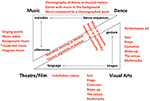
Figure 2. Interactions among the arts. The aforementioned double-triangle representation from Effigy 1 is shown here. In ruby-red text are the six types of two-way interactions between artforms. The directionality of the grey arrows in the top triangle implies that dance is often (though past no ways always) performed to a musical shell, and that songs tin be created past either setting pre-existing texts to music or past adding words to a pre-existing melody. The directionality of the gray arrows in the bottom triangle implies that visual forms—such every bit sets, props, costumes, and make-upwards—are generally created in the service of performance forms, such as theater and dance. Whereas most interactions involve simultaneous combinations of artforms, the interactions marked with asterisks (i.e., incidental music, and dance in exact dramas) are those that tend to occur in alternation with one some other.
Music/Theater Interaction
There are at to the lowest degree five major manners past which music can combine with language and theatrical narratives. The first is a direct coupling between musical pitches and spoken syllables via the singing of words. Compositionally, this can be achieved by either adding text to an existing melody or past setting an existing text to music, the latter procedure referred to as text setting. Note that the text tin can resemble standard spoken language (alike to a play) or tin can be much closer to poetic text, as in many art songs. In improver, the singing of words can occur in wholly sung works like opera, or it can occur in alternation with spoken segments, as in musical theater, vaudeville, opéra comique, and Singspiel. Second, music videos contain the singing of words, only couple that to visual narratives, in virtually all cases occurring in the absence of speech or dialogue. Third, in much picture palace—but in very piffling theater—background music (so-chosen underscore) is played during the dialogue and action of the picture. This is a much looser type of music/narrative coupling than that between pitch and syllable during singing. Fourth, in the case of incidental music, music is performed between the scenes of a play, with well-known examples being Mendelssohn'south music for Shakespeare's A Midsummer Night'due south Dream and Grieg's music for Ibsen's Peer Gynt. Finally, "program music" refers to instrumental musical works composed in such a manner as to map onto the plot line of literary or theatrical works, as is seen in Dvorak'due south Noonday Witch or Tchaikovsky's Romeo and Juliet overture.
Trip the light fantastic toe/Music Interaction
Dance is universally performed to music, including rhythmic-based percussion music; the only existent exceptions are some forms of modernist dance in Western cultures that have no musical accompaniment. The trip the light fantastic toe/music interaction can occur in three major manners. Kickoff, dance can be performed and then as to conform to the meter of the music existence played, as in a waltz or tango. Hence, the dance will exist choreographed such that the largest and strongest movements occur in synchrony with the stiff beats of the music, resulting in a parallel metrical construction betwixt the dance and the music. In addition to dance itself, a similar type of motion/music interaction is plant in certain forms of puppet theater, such as Vietnamese water puppetry. Second, dance can occur without consideration for musical beats. In this instance, the music plays "in the background," and the choreography occurs relatively independent of it. There are many prominent examples in world cultures, peculiarly in narrative forms of dance. Dances tin, of form, employ both types of coupling, synchronizing to musical beats during some dance segments, but non in others. Finally, in some forms of gimmicky dance, composers tin create music for pre-choreographed dance works, hence showing the reverse progression to dance being choreographed to music.
Dance/Theater Interaction
There are two major manners past which dance interacts with theater. Outset, dance can itself exist a type of theater. This is seen peculiarly in the case of narrative forms such as ballet, where dancers portray characters and interact with one another just every bit dramatic characters do, but in the absenteeism of speech. For example, Prokofieff's ballet Romeo and Juliet is a danced and unspoken version of the Shakespeare play, using exactly the aforementioned characters and narrative events as the theatrical version. Second, in the case of dramatic works, dance can be interleaved with non-dance segments of the piece of work. On the i hand, this can occur in completely sung works, such as opera, where the dancing occurs to an instrumental musical accessory, typically in the absenteeism of singing. Well-known examples are found in the operas of the Baroque menses (east.g., the works of Lully, Rameau, and Gluck), where ballet segments are interleaved with the sung segments of the opera. In such forms, the singers are almost never the same people as the dancers. Next, dance segments can be found in spoken dramatic works, the major instance being musical theater. Equally with opera, trip the light fantastic segments are typically interleaved with the verbal part of the work, rather than occurring simultaneously with it. This is, at to the lowest degree in role, an accommodation to the fact that information technology is physically challenging to sing and trip the light fantastic at the same time, although pop singers since the time of Madonna and Michael Jackson accept managed to achieve this in a compelling way, creating the iii-manner interaction between sentences/utterances, melodies, and trip the light fantastic toe sequences. In musical theater, unlike opera, the singers very often perform the dance segments as well, accompanied by a corps of dancers who also make up the musical chorus, as in musicals like Oklahoma and Westward Side Story.
Theater/Visual Arts Interaction
Considering we conceive of the visual arts as being comprised of static objects—bated from some avant garde works of the twentieth and twenty-first centuries described below—the major interaction between the visual arts and performing artforms such as theater is constitute in the static components of theatrical works. This includes the sets, props, costumes, and brand-up. It also includes the architectural features that make upwards the performance venue, including its interior and outside design. Another interaction that we listing in the figure is comprised of films that occur as part of multimedia video installations in art museums. While some of the works are stand-lone videos, others are components of larger installation works that comprise static (or even mobile) visual-fine art objects. While some of these videos incorporate scenes with people in them, many of them exercise non. Some accept sound (including music), while others are purely visual. Hence, this is a hard form to characterize. Nosotros classify it as a visual-arts interaction with film, more and so than ane with theater. Another interesting interaction that is difficult to allocate is the apply of videos or blithe films in performance works, such every bit operas or plays. For case, a product of Shostakovich'southward opera The Nose by the director and designer William Kentridge included a vast collage of both withal images and blithe images that appeared not only betwixt the scenes of the opera only during the scenes as well.
Trip the light fantastic/Visual Arts Interaction
Everything mentioned in the final point virtually sets, props, costumes, brand-upwardly, venue, and multimedia applies here. A broader view of the visual arts, every bit developed in the twentieth century, incorporates a performance component to this branch of the arts. Hence, "performance art" takes the visual arts beyond the domain of static and inanimate images/objects and brings them into the realm of operation (Goldberg, 2011). We could list this as an interaction with either theater or dance (or both), but nosotros include information technology with dance in the figure since information technology often occurs in a wordless manner, more reminiscent of dance than verbal theater.
Music/Visual Arts Interaction
The interactions between the visual arts and music are the least prominent among the interactions described in this section (although see the related word of music video above). Some multimedia installations displayed in museums not simply have sound but include music. Background music is occasionally played ambiently throughout an entire exhibition space so as to give information technology a particular feel, say of a foreign culture whose artifacts are existence exhibited. Outside of the context of museums, one occasionally finds images projected onto surfaces such as walls during musical concerts in concert halls. Music frequently occurs every bit an accompaniment to fireworks displays; composers such equally Handel even created music specifically for such occasions. At the compositional level, at that place are many examples of paintings or sculptures that represent musicians and/or musical instruments (due east.m., Picasso's many cubist guitars), equally well every bit musical works that attempt to represent visual art works (east.k., Mussorgsky's Pictures at an Exhibition, based on paintings by Hartmann).
Having described these two-style interactions (and the three-way interaction of dancing while singing words), we would similar to bespeak out that these interactions can occur either simultaneously or sequentially. The vast majority of interactions shown in Effigy 2 occur such that both artforms play out simultaneously. However, nosotros mentioned previously that sung segments may occur every bit distinct from spoken segments in forms like musical theater, opéra comique, and Singspiel. Two additional examples of sequential interactions are marked with asterisks in the figure. First, in the case of incidental music, the music is interleaved with the dramatic segments of the play, rather than occurring simultaneously with them in the way that underscore does in films. Second, the dance segments found in theatrical forms like opera and musical theater are by and large interleaved with the verbal parts of the drama, although they may occur simultaneously with sung parts in musical theater. Another interesting case to mention in this regard, although non shown in the effigy, is recitative in opera, which differs from the primary segments of the opera in that the vocal style is much closer to voice communication than to standard singing. This blazon of sing-song speaking affords an audience the opportunity to acquire more narrative information nearly the plot than is more often than not possible in the sung segments. Withal, what is of importance hither is that segments of recitative typically occur separately from those that are sung. In general, the 2 vocal styles are not blended inside a single scene. The few examples of blending that come up to listen are the Caucasian characters in Gershwin'southward opera Porgy and Bess who only speak but who interact with characters who sing, and Sprechstimme characters like Moses in Schoenberg's opera Moses und Aron who interact with characters who sing.
With this conception of artforms and their interactions in heed, nosotros can now think about how to build a Gesamtkunstwerk. Figure 3 shows eight forms of the performing arts forth the summit. These are then classified with respect to their inclusion of four functioning modalities: the speaking voice, the singing vox, instrumental music, and dance (and/or mime). The vertical arrows in the figure suggest that singing and dancing typically occur to the beat of instrumental music in these artforms. The dashed line for "music concert" implies that singing tin have instrumental accompaniment, but that it can besides be done all on its own, but the mode that instrumental music tin exist washed. At the extremes of the scheme are the to the lowest degree synthetic artforms of theater (speaking voice only) and mime (gesture simply), although theater tin involve incidental music, and mime can be performed to music, since information technology was initially conceived of as a form of dance (Hall, 2009). In the eye of the scheme sit the most synthetic forms. A major observation from this figure is that musical theater is the true Gesamtkunstwerk in Western art. Within the context of not-Western art, Peking opera shares all of the features of musical theater, making prominent use of dance and acrobatics. Richard Wagner, for all his aspirations to develop a total work of art, never included dances in his operas (although he mentions dance oft in his writings, come across Wagner, 1849), nor annihilation resembling standard speech. Hence, the Baroque operas that preceded Wagner (and that he despised) were probably closer to being total works of fine art than Wagner'south own music-dramas.
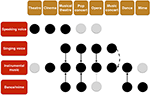
Figure three. The performing arts with respect to functioning modalities. The effigy shows eight forms of the performing arts forth the top. These are then classified with respect to their inclusion of four functioning modalities: the speaking vox, the singing voice, instrumental music, and dance (and/or mime). Blackness circles imply the presence of a given modality in a given artform. The vertical arrows suggest that singing and dancing are very often done to the shell of instrumental music in these artforms. The dashed arrow for "music concert" implies that singing tin can be done either a capella or to instrumental accompaniment; also, instrumental music can be performed all on its own. Operation art (not shown here) sits in the categories represented by trip the light fantastic and mime. Gray circles imply secondary uses of modalities. These include the occurrence of instrumental underscore in theater works, spoken segments in popular concerts and opera, trip the light fantastic toe segments in opera, and instrumental underscore in pantomime works.
While the focus of this commodity is on the performing arts, it should be mentioned that the field of "multimedia" presents its own type of synthesis of the arts (Costello, 2016), combining relatively static elements, such as all the same images and text, with dynamic audiovisual elements, such as video, blitheness, and music (Tan et al., 2013), and often doing and so in a far more interactive style than is mostly the case in the performing arts. Finally, at a more elemental level, even still images similar paintings can exist seen as syntheses, integrating class, colour, spatial organization, texture, implied depth, unsaid move, symbolic content, and so forth.
Ceremonial Rituals equally Total Works of Art
The previous department established a recipe for edifice a total work of art past describing the ways in which the arts can exist combined to generate synthetic forms. This has of import ramifications for both historical accounts of the arts and the role of the arts in gimmicky society. We contend that the nineteenth century notion of a Gesamtkunstwerk is neither new nor revolutionary. Ceremonial rituals in ethnic cultures across the world have manifested this do ever since their inception, and accept probably done so on a larger spatiotemporal scale and in a more participatory fashion than theorists similar Wagner could have imagined. In this section, we explore two complementary proposals, outset that ceremonial rituals—and specifically religious formalism rituals—are so intimately connected with the arts that they can exist conceived of equally assemblages of the arts, and second, that these ceremonies were in fact the original GKW's in human societies. Effigy iv volition serve every bit a guide for the discussion.
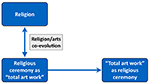
Figure 4. The relationship between faith, the arts, and the Gesamtkunstwerk. The hypothesis of religion/arts co-evolution (RACE) argues that the emergences of religious practice and the arts are intimately interwoven during man history. The common point of focus is the ceremonial ritual, which is proposed to be a collection of arts behaviors and objects, making it essentially a "total piece of work of art." The aesthetic Gesamtkunstwerk after evolved in large-calibration cultures in the context of creative practice. It has a stiff spiritual and ceremonial dimension to it, reminiscent of a religious ritual.
Religion/Arts Co-evolution
Since the start of the 20-first century, there has been a surge of interest in the development and biology of religion (e.g., Barrett, 2000; Wilson, 2002; Bulbulia, 2004; Alcorta and Sosis, 2005; Johnson and Bering, 2006; Boyer and Bergstrom, 2008; Norenzayan and Shariff, 2008). Two principal issues dominate the discussions, commencement why people believe in supernatural beings and their agency, and 2nd why people engage in elaborate group rituals that can last up to several days and that eat vast amounts of valuable resources, both material and personal. Nosotros tin can retrieve of the get-go i as a cognitive consequence and the second as behavioral.
Evolutionary psychologists have proposed a number of functional or causal mechanisms to explain the adaptive advantage of religious behavior. Regarding belief in supernatural beings, it has been proposed that pro-social behaviors can exist promoted past means of the moralizing strength of such agents (east.thousand., Johnson, 2006, 2015). A supernatural being functions as a surrogate dominance figure, especially one that operates when other humans are not around to observe and regulate one'due south behavior. People believe that they can avert disfavor or punishment from the supernatural being past refraining from engaging in self-serving and antisocial behaviors and by acting kindly toward and cooperatively with other members of their social group. A belief in supernatural agency is essentially the application to physical phenomena of what Bruner (1986) calls the "narrative fashion" of cognition. In the absence of concrete theories to explain natural phenomena, people "narrativize" these natural events in terms of the intentionality of a supernatural being, with the implication being that these phenomena happen "for a reason," in the same fashion that human beliefs is believed to happen (Bering, 2002).
While this causal blazon of explanation for belief in supernatural beings is specifically connected with faith, the behavioral explanation for religious group rituals is no unlike from that for non-religious group rituals: creating solidarity and coordination inside a group, ultimately leading people to cooperate with i some other and make personal sacrifices on the group's behalf (Sosis and Alcorta, 2003; Cohen et al., 2010; Whitehouse and Larman, 2014; Legare and Watson-Jones, 2015). Synchronization of movement and emotional expression through group rituals fosters a communitarian sense of belonging to the grouping and reduces barriers for cooperation with group members, not to the lowest degree with not-kin (Ruby-red et al., 2013; Launay et al., 2016). In particular, singing, dancing, and drumming all trigger endorphin release in contexts where simply listening to music or performing low-energy musical activities does not (Dunbar et al., 2012). This has led researchers to conclude that active participation in ritual musical performance and dancing is likely to stimulate these same neuropeptide systems and thereby give rise to the kinds of euphoric effects noted by Durkheim (1912/1995, his "collective effervescence"), Turner (1966), Roederer (1984), and others. These authors further note that these effects may play a particularly of import function for humans in bonding social groups together (come across also McNeill, 1995; Freeman, 2000; Dunbar, 2008).
Few evolutionary scholars accept appreciated or even recognized that the arts in ceremonial rituals have been integral to religion as a behavioral and cognitive miracle. Examples of this omission include scholars such as Guthrie (1993), Hinde (1999), Pyysiäinen (2001), Boyer (2001), Atran (2002), McCauley and Lawson (2002), Kirkpatrick (2005), and Rossano (2010), although Alcorta and Sosis (2005) recognize the importance of the arts in ritual ceremonies for instilling cooperation and solidarity. Nosotros believe that this is far more an issue of neglect than one of disagreement. Hence, a major objective of the present commodity is to hash out this neglect and provide a framework for thinking near the religion/arts connectedness in a principled manner. Because of the inseparability of the two (religious practice and arts-like behavior), it is plausible to suggest that the arts—specially those that have place in fourth dimension, such as song, trip the light fantastic toe, and rhythmic or repetitive forms of movement or speech—arose during human being history as components of ceremonial behavior, rather than every bit independent activities (Dissanayake, 1988, 1992).
In trying to connect the two major problems of conventionalities and ritual in models of religion, there appears to be a significant gap. As mentioned above, not-religious communal behaviors that are synchronized and rhythmic seem to be quite efficacious at creating group cohesion (Cohen et al., 2010; Reddish et al., 2013; Launay et al., 2016), without requiring supernatural belief. Too, conventionalities in supernatural beings for many people, fifty-fifty in contemporary club, can operate effectively at the personal level, without requiring group rituals. And then, what is the missing link that makes religious conventionalities something that requires communal rituals, and that makes ritual into a manifestation and reinforcer of religious belief? We suggest that information technology is the arts. We propose that the arts provide an emotionally-felt and transcendent means of establishing contact with supernatural beings during communal ceremonial rituals. Such contact tin can be equally simple as drawing the being'southward attention to oneself, all the way to the expressions of request, penitence, praise, etc., that underlie worship in large-scale religions (Ladd and Spilka, 2002; Spilka et al., 2003; Poloma and Lee, 2011).
Dissanayake'south (1988, 2009) concept of "artification" (or "making special") is relevant hither. The kinds of arts behaviors that are found in religious rituals beyond cultures—from incantations to drumming to gestural displays to elaborate regalia to body ornamentation to incense—are ways of making the occasion (with its wish, desire, plea, or need) special and thus distinct from the mundane actions and communications amid humans that occur in everyday settings. In improver, they are ways of making oneself special (self-artification), thereby presenting oneself appropriately to a transcendent existence. In religious ceremonial rituals, both the communicator and the communication process get strongly artified. This investment in extravagance demonstrates that the performers "really mean it," that is, that the topic of the ritual is an important and communally-shared thing, for example subsistence, safety, health, prosperity, fertility, or transitioning to a new stage of life.
Hence, arts-permeated religious ceremonial rituals are intended to attract and plant contact with supernatural beings, creating a sanctified realm of interaction singled-out from ordinary social interactions. These manifestations are meant to influence the actions of these supernatural beings toward item individuals and/or the social grouping as a whole. The arts, as manifested in ceremonial rituals, are substantially acts of persuasion. This idea is consequent with work on Western religions showing that worship aims to identify the worshiper in a positive light with respect to gods, such that requests of gods are accompanied by conciliatory expressions of praise, thanks, and confession (Ladd and Spilka, 2002; Spilka et al., 2003; Poloma and Lee, 2011). Information technology needs to be pointed out that not all forms of religious behavior need exist extravagant. Our ideas employ first and foremost to communal formalism rituals, where the presence of arts behaviors and objects is quite compelling. However, there are forms of private penitence (fasting, mortification of the flesh), cede, and personal prayer, including meditative prayer (Poloma and Pendelton, 1989), that may exist quite ascetic and that may even aspire toward a renunciation of material objects. However, these behaviors, in general, are still "ritualized" in the ethological sense (Dissanayake, 1988, 1992), as described in the next paragraph.
Numerous theorists accept written virtually the nature of ceremonial rituals from an anthropological perspective, especially in traditional societies (Durkheim, 1912/1995; Turner, 1966; Schechner, 1974, 1985; Tambiah, 1979; Dissanayake, 1988, 1992, 2017; Rappaport, 1999). Formalism processes are highly ritualized, involving particular locations and times of twenty-four hours, and employing a large caste of repetitive activeness. This is seen especially with body movements and song chants. The process of "ritualization" when applied to animal courtship and territorial behaviors refers to item changes or "operations" that brand the activity prominent, distinctive, and unambiguous (Smith, 1977; Eibl-Eibesfeldt, 1989). Unlike the original instrumental or ordinary precursor-beliefs that inspired them, ritualized movements and sounds go "extraordinary" and thus attract attention (Dissanayake, 1988). They typically become (a) simplified or stereotyped (formalized), and (b) repeated rhythmically, frequently with a "typical" intensity Morris (1957), that is, with a characteristic regularity of pace. The signals are oft (c) exaggerated in time and space, and (d) are further emphasized or elaborated by the development of special colors or anatomical features. These components are polymodal in that they can occur visually, vocally, or gesturally in both space and time. These well-described characteristics of the ritualization process in animals are also distinct and conspicuous in human ritual ceremonies and are characteristic of the arts.
In traditional cultures, human rituals are highly participative and communal, blurring the standard Western distinction between creators, performers, and spectators. The "persuasion" effect of the arts during ceremonial rituals has an affect non but on the supernatural beings being honored and entreated but besides on the participants themselves. Arts-saturated rituals deed as emotional reinforcers of the belief systems beingness communicated during the ritual, ultimately supporting a sense of consensus amidst members of the group with respect to these conventionalities systems. Interestingly, compared to the neophilia of modern art, ritual activities are highly conservative, since they are driven by a social demand to uphold and perpetuate tradition, serving both to respect the deportment of ancestors and to maintain group identity (Coe, 2003). Because of their critical importance to the life of a social group, rituals show very tedious rates of change compared to non-ritual behaviors and products, making them amidst the most persistent features of whatever civilization, whether that be a large-scale culture or an ethnic culture. Pop music may change by the season, but religious music can persist for centuries if non millennia.
Although a scientific worldview would exist skeptical of the idea that artified rituals themselves are effective at resolving the vital pragmatic problems that inspire them, for example those related to successful hunting or influencing conditions patterns, nosotros consider them valuable in that they address and satisfy evolved emotional needs in human psychology. Rituals, through their characteristic operations, create and reinforce emotionally-satisfying and psychologically-necessary feelings of mutuality and intimacy with other people (Bowlby, 1946; Miller and Rodgers, 2001; Dissanayake, 2011), besides as a sense of belonging to a group (Hinde, 1974; Baumeister and Leary, 1995; Dissanayake, 2000; Gratier and Apter-Danon, 2009). They coordinate and unify group members in a reassuring feeling of "oneheartedness" that provides an affective foundation for collective and cooperative behaviors that can be both risky and costly. They promote vii social functions that, in the realm of musical participation, accept been referred to as the 7 C's, namely contact, social cognition, co-pathy (being empathically affected and then that inter-individual emotional states become more homogeneous), communication, coordination, cooperation, and cohesion (Koelsch, 2013), ultimately leading to a sense of community (an Eighth C).
Overall, we accept proposed here a model of religion/arts co-evolution (RACE). The arts evolved in the context of religion, and religion evolved in the context of arts-based group rituals, where the two interfaced nearly strongly at the level of formalism rituals. The arts most probable arose in human history every bit communicative components of propitiary and supplicatory group rituals, rather than every bit independently-evolved activities, hence making the unification of organized religion and the arts a natural coupling. Evolutionary theorists of organized religion regularly make mention of group rituals, but not of their pervasive arts components. Secular group rituals might have been sufficient on their own for promoting the survival needs of grouping living, but religious rituals redirect the focus toward a moral force that is higher, stronger, and more constructive than any single member of the group (Johnson, 2015), which is not the case in secular rituals. For this reason, they are probably more than efficient at engendering coordination strength, group identity, and interpersonal cooperation. A large investment is made by group members in establishing this specialized way of contact with supernatural powers, with the hope of achieving desirable outcomes and of alleviating adverse weather condition.
Emile Durkheim's classic book The Unproblematic Forms of Religious Life (1912/1995) presents a wide-ranging early analysis of religious rituals in indigenous cultures. Importantly for our purposes, Durkheim'southward perspective of ritual is grounded in a vast fusion of artforms, one that includes not only singing and dancing, but face painting, body decoration, mime, costume, cartoon, oral storytelling, and the theatrical conveyance of the myths and prospects of a culture through "sacred drama". Watts Miller (2013) refers to this fusion as Durkheim's "full aesthetics." Therefore, Durkheim might have been the primeval thinker to suggest that religious ceremonial rituals served as the ancestral roots of GKW's. Such rituals, through their promotion of grouping assembly and communal participation, bind people together via a process that Durkheim calls collective effervescence, a procedure that is strongly linked to the effects of the arts components of these rituals.
Finally, a similar perspective can be found in Richard Schechner'due south writings about the emergence of theater from religious ritual, and even the opposite development of ritual from theater. While Schechner (1974) describes the multi-arts nature of rituals—combining dance, music, drama, and elaborate torso ornamentation—his master focus is on how the purposeful efficacy of rituals becomes transformed into the entertainment function of theater, an inter-human relationship that he refers to as the "efficacy/entertainment braid." Hence, his hypothesis is less a religion/arts model equally an historical account of how cultural practices accept changed from being ritual-centric to becoming entertainment-centric. For example, in analyzing European history, he states that "[T]he belatedly medieval menses was dominated past efficacious performances: church services, court ceremonies, moralities, pageants. In the early on Renaissance these began to turn down and pop entertainments, ever nowadays, gained, finally becoming dominant in the course of the public theaters of the Elizabethan menses" (Schechner, 1974, p. 470).
Ceremonies as Collections of Arts Behaviors
The major observation that emerges from the RACE hypothesis is that formalism rituals are so filled with arts behaviors and objects that if one were to take away these arts components 1 by ane, at that place would be little that would remain with respect to grouping behaviors and shared symbolic objects. (Of grade, private-level processes would remain, such as cognitive and emotional connections with supernatural beings). This leads us to postulate that religious ceremonial rituals, at the behavioral and material levels, tin can be considered as being reducible to collections of arts behaviors and objects. Table 1 presents a general enumeration of the types of arts-related behaviors and objects that are found in some or all ceremonial rituals in globe cultures, covering music, dance, language use, drama, the visual arts (regalia, masks, artifacts, body ornamentation, etc.), and the chemic arts (such as materials that are smelled or consumed); these artforms can readily interact to form blends, either simultaneously or sequentially (Figures 2, iii). Information technology is difficult to conceive of religious ceremonial rituals without these behaviors and implements. Without these "transfigurations of the commonplace" (Danto, 1981), it is difficult to imagine what would found a ceremony. The more that one looks toward indigenous cultures, the more than pervasive and necessary these arts-related elements seem to be in the performance of grouping rituals. The arts are not ancillary add together-ons, but are instead essential components of the ritual. In fact, an absence of these behaviors or their improper execution tin contaminate or invalidate the ritual, with potentially severe repercussions for those involved, including death (Liénard and Boyer, 2006). Overall, we feel that the ceremonies-as-arts perspective provides compelling support for the RACE model.
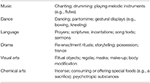
Tabular array 1. Artforms found in religious formalism rituals.
The Ceremonial Ritual as the Precursor of the Total Work of Fine art
To now bring the statement of this commodity full circle, nosotros propose that long earlier artful theorists had devised the notion of a Gesamtkunstwerk, ceremonial rituals in ethnic cultures had for millennia been syntheses of the arts on a similar scale and of a like scope to GKW's. In other words, ceremonial rituals are the historical precursor to what aesthetic philosophers would afterward telephone call GKW's in artistic practice. The complementary idea, as shown on the right side of Figure 4, is that GKW'due south themselves came to adopt quasi-religious practices and so as to become ceremonies in their own right. Wagner's music-dramas are the virtually historic case of this (Smith, 2007). The GKW would take place in a grandiose setting akin to a temple of the arts, to which the spectators would brand a pilgrimage. The work would deal with spiritual and mythological themes that would ship the work out of the mundane and technological earth of today and bring the audience dorsum to its cultural roots. The work would combine theater, music, poetic language, and elaborate visuals into a "pseudo-organic totality" whose performance would occur over a time bridge much longer than a standard concert or theater performance. The experience would be transformative for those in attendance, rather than beingness a form of entertainment and diversion. It would be something along the lines of a religious experience, a route to redemption through the arts. This notion of arts-equally-religion came to permeate much thinking about the arts in the late nineteenth and early twentieth centuries and is non altogether absent in our times. "Dandy art," and indeed participation in the arts in full general, is nevertheless idea to nourish people's spiritual side and better their well-beingness. This is 1 of the planks that motivates the use of individual arts for therapeutic purposes, including therapies based on music, dance, writing, verbal expression, role playing, and painting (Gladding, 2011). In addition, in the late twentieth century, in that location was a notable impetus to use the arts as a means of promoting learning in the classroom. In some respects, we oasis't moved very far away from Schiller's 1794 notion of aesthetic didactics (Smith, 2007).
Conclusions
The nineteenth century concept of a Gesamtkunstwerk has deep evolutionary roots in religious practice across cultures, as suggested by anthropological and ethological analyses of the arts. Ceremonial rituals, especially the blazon that permeate religious exercise, can exist considered essentially every bit assemblages of arts behaviors and objects, making them the precursor of what would afterwards exist called the total work of art in aesthetic practice, with its own quasi-religious flavor. We take presented a framework for describing how a total work of art tin be constructed past identifying the manners in which the arts can combine, involving both simultaneous and sequential interactions between artforms. Such combinations are seen ubiquitously non only in fine art works simply in ceremonial rituals of all kinds, suggesting a strong co-evolutionary relationship betwixt organized religion and the arts.
Writer Contributions
Both SB and ED conceived of the ideas of this paper and wrote the manuscript.
Conflict of Interest Statement
The authors declare that the enquiry was conducted in the absence of whatever commercial or financial relationships that could be construed as a potential conflict of interest.
Acknowledgments
This work was supported past a grant from the Social Sciences and Humanities Enquiry Council (SSHRC) of Canada to SB. We thank students in SB's undergraduate class The Science of Performance for critical commentary on the manuscript, and appreciate the helpful suggestions of two reviewers.
Footnotes
1. ^We are using the term "theater" here to signify narrative artforms that are expressed through either acting or storytelling. While acting is always performative, storytelling can be done in either a performative manner (oral forms of storytelling and verse) or, in literate societies, in a written—hence not-performative—mode. This creates a complication for our scheme. Technically speaking, written literature belongs together with the visual arts, since written text is a type of two-dimensional prototype (Elkins, 1999). While we acknowledge this complication in classifying written forms of narrative in our scheme, nosotros will non bargain whatsoever farther with this consequence in the current article.
References
Atran, Southward. (2002). In Gods We Trust: The Evolutionary Mural of Religion. New York, NY: Oxford University Printing.
Google Scholar
Barrett, J. 50. (2000). Exploring the natural foundation of religion. Trends Cogn. Sci. 4, 29–34. doi: 10.1016/S1364-6613(99)01419-9
CrossRef Full Text | Google Scholar
Baumeister, R. F., and Leary, M. R. (1995). The demand to belong: desire for interpersonal attachments equally a fundamental human motivation. Psychol. Bull. 117, 497–529. doi: ten.1037/0033-2909.117.3.497
PubMed Abstract | CrossRef Full Text | Google Scholar
Boyer, P. (2001). Religion Explained: Evolutionary Origins of Religious Thought. New York, NY: Basic Books.
Google Scholar
Boyer, P., and Bergstrom, B. (2008). Evolutionary perspectives on religion. Annu. Rev. Anthropol. 37, 111–130. doi: 10.1146/annurev.anthro.37.081407.085201
CrossRef Full Text | Google Scholar
Bruner, J. (1986). Bodily Minds, Possible Worlds. Cambridge, MA: Harvard University Press.
Google Scholar
Bulbulia, J. (2004). The cognitive and evolutionary psychology of religion. Biol. Philos. 19, 655–686. doi: ten.1007/s10539-005-5568-vi
CrossRef Full Text | Google Scholar
Coe, K. (2003). The Ancestress Hypothesis: Visual Fine art as Adaptation. New Brunswick, NJ: Rutgers University Press.
Google Scholar
Cohen, E. Eastward., Ejsmond-Frey, R., Knight, N., and Dunbar, R. I. (2010). Rowers' loftier: behavioural synchrony is correlated with elevated pain thresholds. Biol. Lett. half dozen, 106–108. doi: 10.1098/rsbl.2009.0670
PubMed Abstract | CrossRef Total Text | Google Scholar
Costello, V. (2016). Multimedia Foundations: Cadre Concepts for Digital Pattern, 2nd Edn. New York, NY: Routledge.
Google Scholar
Danto, A. (1981). The Transfiguration of the Commonplace. Cambridge, MA: Harvard University Press.
Google Scholar
Dissanayake, E. (1988). What is Art For? Seattle, WA: University of Washington Press.
Google Scholar
Dissanayake, E. (1992). Homo Aestheticus: Where Art Comes From and Why. Seattle, WA: Academy of Washington Press.
Google Scholar
Dissanayake, East. (2000). Art and Intimacy: How the Arts Began. Seattle, WA: University of Washington Press.
Google Scholar
Dissanayake, E. (2009). The artification hypothesis and its relevance to cognitive scientific discipline, evolutionary aesthetics, and neuroaesthetics. Cogn. Semiot. v, 148–173. doi: 10.1515/cogsem.2009.5.fall2009.136
CrossRef Total Text | Google Scholar
Dissanayake, Eastward. (2011). Prelinguistic and preliterate substrates of poetic narrative. Poet. Today 32, 55–79. doi: x.1215/03335372-1188185
CrossRef Full Text | Google Scholar
Dissanayake, East. (2017). "From play and ritualisation to ritual and its arts: sources of Upper Pleistocene ritual practices in Lower Middle Pleistocene ritualised and play behaviours in ancestral hominins," in Ritual, Play and Conventionalities in Early on Human Societies, eds C. Renfrew, I. Morley, and M. Boyd (Cambridge: Cambridge University Press), 87–98.
Dunbar, R. I. One thousand. (2008). Listen the bonding gap: or why humans aren't just great apes. Proc. Br. Acad. 154, 403–423. doi: x.5871/bacad/9780197264355.003.0015
CrossRef Full Text
Dunbar, R. I., Kaskatis, K., MacDonald, I., and Barra, V. (2012). Performance of music elevates pain threshold and positive affect: implications for the evolutionary function of music. Evol. Psychol. 10, 688–702. doi: 10.1177/147470491201000403
PubMed Abstract | CrossRef Full Text | Google Scholar
Durkheim, East. (1912/1995). The Simple Forms of Religious Life. Transl. by M. E. Fields. New York, NY: The Free Press.
Eibl-Eibesfeldt, L. (1989). Human Ethology. Transl. by P. Wiessner-Larsen and A. Heunemann.New York, NY: Aldine de Gruyter.
Google Scholar
Elkins, J. (1999). The Domain of Images. New York, NY: Cornell Academy Press.
Google Scholar
Freeman, Westward. J. (2000). "A neurobiological office of music in social bonding," in The Origins of Music, eds N. Wallin, B. Merker, and S. Brown (Cambridge, MA: MIT Press), 411–424.
Gladding, S. T. (2011). The Creative Arts in Counseling, 4th Edn. Alexandria, VA: American Counseling Association.
Goldberg, R. (2011). Performance Art: From Futurism to the Present, 3rd Edn. London: Thames & Hudson.
Gratier, M., and Apter-Danon, G. (2009). "The improvised musicality of belonging: repetition and variation in female parent-infant vocal interaction," in Communicative Musicality: Exploring the Basis of Human Companionship, eds S. Malloch and C. Trevarthen (Oxford: Oxford University Press), 301–327.
Guthrie, S. Due east. (1993). Faces in the Clouds: A New Theory of Religion. Oxford: Oxford University Press.
Google Scholar
Hall, E. (2009). "Introduction: Pantomime, a lost chord of aboriginal culture," in New Directions in Aboriginal Pantomime, eds Due east. Hall and R. Wyles (Oxford: Oxford University Press), ane–40.
Hinde, R. A. (1974). Biological Bases of Human being Social Behaviour. New York, NY: McGraw-Colina.
Google Scholar
Hinde, R. A. (1999). Why Gods Persist: A Scientific Approach to Religion. London: Routledge
Google Scholar
Johnson, D. (2015). God is Watching You: How the Fright of God Makes Us Human. Oxford: Oxford Academy Press.
Google Scholar
Johnson, D., and Bering, J. (2006). Mitt of God, mind of man: punishment and cognition in the evolution of cooperation. Evol. Psychol. iv, 219–233. doi: 10.1177/147470490600400119
CrossRef Total Text | Google Scholar
Johnson, D. D. (2006). God's penalization and public goods: a test of the supernatural punishment hypothesis in 186 world cultures. Hum. Nat. xvi, 410–444. doi: 10.1007/s12110-005-1017-0
PubMed Abstract | CrossRef Full Text
Kimmel, Thousand., and Preuschl, E. (2016). "Dynamic coordination patterns in tango argentino: a cantankerous-fertilization of subjective explication methods and motion capture," in Dance Notations and Robot Motion, eds J. L. Laumond and North. Abe (New York, NY: Springer), 209–235.
Google Scholar
Kirkpatrick, Fifty. A. (2005). Attachment, Evolution, and the Psychology of Religion. New York, NY: Guilford.
Google Scholar
Ladd, One thousand. L., and Spilka, B. (2002). Inward, outward, and upwardly: cerebral aspects of prayer. J. Sci. Report Relig. 41, 475–484. doi: ten.1111/1468-5906.00131
CrossRef Full Text | Google Scholar
Launay, J., Tarr, B., and Dunbar, R. (2016). Synchrony as an adaptive machinery for big-scale human social bonding. Ethology 122, 779–789. doi: 10.1111/eth.12528
CrossRef Full Text | Google Scholar
Legare, C. H., and Watson-Jones, R. E. (2015). "The evolution and ontogeny of ritual," in The Handbook of Evolutionary Psychology, ed D. 1000. Kiss (Hoboken, NJ: Wiley Sons), 829–847.
Google Scholar
Liénard, P., and Boyer, P. (2006). Whence collective rituals? A cultural pick model of ritualized behavior. Am. Anthropol. 108, 814–827. doi: 10.1525/aa.2006.108.4.814
CrossRef Full Text
McCauley, R. Northward., and Lawson, E. T. (2002). Bringing Ritual to Mind. New York, NY: Cambridge University Press.
Google Scholar
McNeill, West. H. (1995). Keeping Together in Time: Dance and Drill in Human History. Cambridge, MA: Harvard University Press.
Miller, W. B., and Rodgers, J. L. (2001). The Ontogenesis of Human Bonding Systems: Evolutionary Origins, Neural Bases, and Psychological Manifestations. Boston, MA; Dordrecht: Kluwer Academic Publishers.
Google Scholar
Morris, D. (1957). "Typical intensity" and its relation to the trouble of ritualization. Behaviour 11, ane–2.
Google Scholar
Patel, A. D. (2008). Music, Language and the Brain. Oxford: Oxford Academy Press.
Poloma, M. Thousand., and Lee, M. T. (2011). From prayer activities to receptive prayer: godly love and the knowledge that surpasses understanding. J. Psychol. Theol. 39, 143–154. doi: x.1177/009164711103900205
CrossRef Full Text
Poloma, Yard. Grand., and Pendelton, B. F. (1989). Exploring types of prayer and quality of life: a inquiry note. Rev. Relig. Res. 31, 46–53. doi: 10.2307/3511023
CrossRef Full Text | Google Scholar
Pyysiäinen, I. (2001). How Religion Works: Towards a New Cerebral Science of Religion. Leiden: Brill.
Rappaport, R. A. (1999). Ritual and Faith in the Making of Humanity. Cambridge: Cambridge Academy Press.
Google Scholar
Rossano, M. (2010). Supernatural Pick: How Religion Evolved. Oxford: Oxford Academy Press.
Google Scholar
Schechner, R. (1974). From ritual to theatre and dorsum: the structure/procedure of the efficacy-entertainment dyad. Educ. Theat. J. 26, 455–481. doi: ten.2307/3206608
CrossRef Full Text | Google Scholar
Schechner, R. (1985). Between Theater and Anthropology. Philadelphia, PA: University of Pennsylvania Press.
Google Scholar
Smith, M. W. (2007). The Total Work of Art: From Bayreuth to Net. New York, NY: Routledge.
Google Scholar
Smith, W. (1977). The Behavior of Communicating: An Evolutionary Approach. Cambridge, MA: Harvard Academy Press.
Google Scholar
Sosis, R., and Alcorta, C. S. (2003). Signaling, solidarity and the sacred: the evolution of religious behavior. Evol. Anthropol. 12, 264–274. doi: 10.1002/evan.10120
CrossRef Full Text | Google Scholar
Spilka, B., Hood, R. West. Jr., Hunsberger, B., and Gorsuch, R. 50. (2003). The Psychology of Religion: An Empirical Arroyo, 3rd Edn. New York, NY: Guilford.
Tambiah, Due south. J. (1979). A performative approach to ritual. Proc. Br. Acad. 65, 113–169.
Tan, S.-Fifty., Cohen, A. J., Lipscomb, Southward. D., and Kendal, R. A. (2013). The Psychology of Music in Multimedia. Oxford: Oxford University Press.
Google Scholar
Turner, V. (1966). The Ritual Process: Structure and Anti-Structure. Ithaca: Cornell University Press.
Google Scholar
von Scheve, C., and Salmella, 1000. (2014). Commonage Emotions: Perspectives from Psychology, Philosophy, and Folklore. Oxford: Oxford University Printing.
Wagner, R. (1849). The Artwork of the Hereafter. Transl. past W. A. Ellis. Lincoln, NB: Academy of Nebraska Press.
Google Scholar
Watts Miller, W. (2013). "Total aesthetics: art and the elemental forms," in Durkheim, the Durkheimians, and the Arts, eds A. Riley, Westward. S. F. Pickering, and W. Watts Miller (New York, NY: Berghahn Books), sixteen–42.
Google Scholar
Whitehouse, H., and Larman, J. A. (2014). The ties that bind us: ritual, fusion, and identification. Curr. Anthropol. 55, 674–695. doi: 10.1086/678698
CrossRef Full Text | Google Scholar
Wilson, D. S. (2002). Darwin'due south Cathedral: Development, Faith, and the Nature of Society. Chicago, IL: University of Chicago Press.
Google Scholar
Yuan, Y., Major-Girardin, J., and Chocolate-brown, Southward. (in printing). Storytelling is intrinsically mentalistic: an fMRI report of narrative production across modalities. J. Cogn. Neurosci.
Source: https://www.frontiersin.org/articles/10.3389/fsoc.2018.00009/full
0 Response to "Art That Would Have Been Used in a Ritual"
Post a Comment