Steely Dan Do It Again Typography
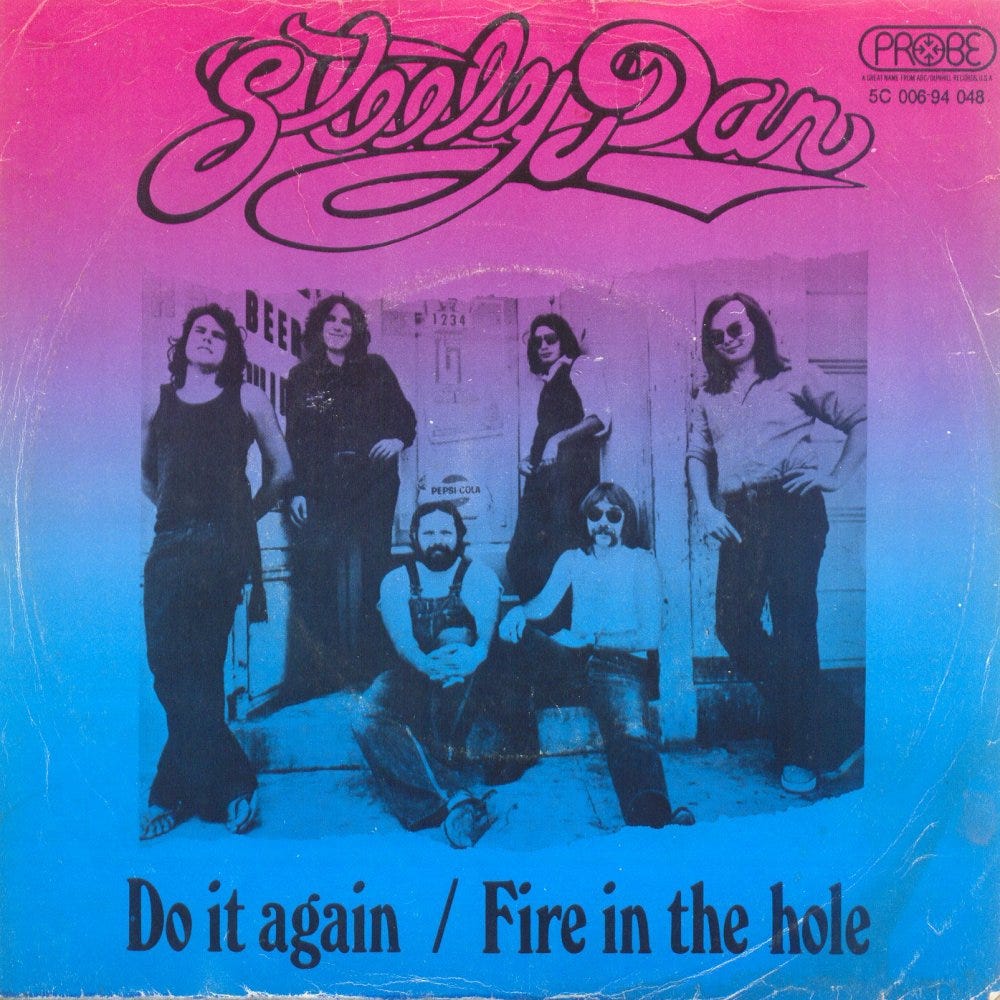
Steely Dan already had a very good conga actor already in the band, guitarist Jeff "Skunk" Baxter worked percussion on this song in a live setting but Walter Becker and Donald Fagen idea information technology best to track in Feldman, an English session player famous for his work on Miles Davis' 'Seven Steps to Heaven' LP.
Songwriters Becker and Fagen weren't ducking this twist, the first striking. The showtime song on Steely Dan's debut album, the first unmarried off 'Can't Buy a Thrill.'
After the demoing years charged him with supplying the lines necessary for the listener to place the more than orthodox harmonic structures in the duo'due south driving songs, bassist Becker was finally freed to float with headphones on. Recorded inside the months of earnest attempts to replace himself as his band'south lead singer, Fagen lives confidently within his double-tracks.
Donald's not finished, if the temperature will e'er let him tune up. Somewhere in the middle of the song, just subsequently the radio said "plenty," lurks a deliciously inappropriate "plastic" combo organ solo no doubt egged on with Walter's snorting encouragement.
It'southward the type of musical instrument – never used once again past the ring – that would later sneer its way to smashing acclamation after in the 1970s, powering Elvis Costello's Attractions and other lightly lads. Here, on Side One (Track One), information technology'due south simply a thing that sounds weird enough to be left on the side of the road after the carful was done with it.
Becker and Fagen spent the concluding fits of New York'due south 1960s in Park Slope trying to make rent with pop tunes spun as earnestly as their souls at the time would permit. They backed Jay and the Americans on live dates and were paid in whatever was left over after the beaks did their worst. Steely Dan was pulling down on calculated gambles long before Encino saved its thumbs from the freeze.
After moving to Los Angeles the pair scored a melody on a Streisand album, they considered Denny Doherty and they wrote for John Kay. Becker and Fagen penned and subsequently even performed 'Change of the Guard' in full view of Dias and his rosary beads, stating that they intended it for release.
'Dallas,' a land-pop soft release single sung by the tawny yet contained Jim Hodder, the ring's drummer, was hesitantly considered every bit Steely Dan's initial offer. David Palmer was brought in to hit the Laura Nyro notes and to look a lilliputian like Roger Daltrey to the overserved.
Concessions were attempted, picks were rolled with. This was a duo that was non going to turn downward subversively sporty cars (licenses had to come first), interesting girlfriends, and better gear – future accommodations had to be considered, and swiftly.
And they led everything off with, I don't know, a bossa nova?
It's vi minutes long and Donald Fagen sings it with that voice and information technology's a massive striking. If the admitted aesthete to launch for was midway between Word Jazz and Rubber Soul, and then the Dan was well on its way.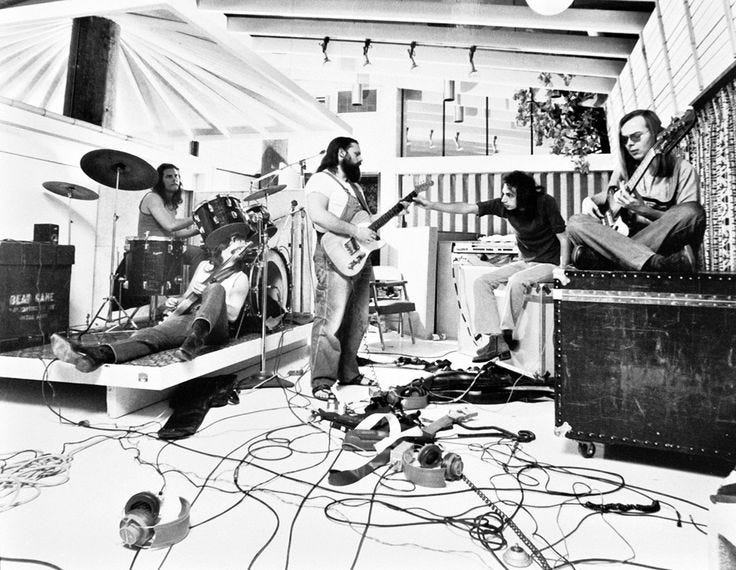
The tagger at this point reads just in the 1970s! and it's a kiss-off that I've listened to Becker, Fagen and Baxter all conclude with. To calm insistent interviewers and re-amuse themselves at the wickedness of how wondrously daffy it is that a song similar this could go a nautical chart-topper in 1972.
When anyone else of a certain historic period spits that line out, information technology falls a footling flatter in its nod to an imagined decade where Richard Dreyfuss was the merely male sexual practice symbol, where Grand Funk never happened.
Like, at some point information technology'south got to become a Steely Dan thing, right? It's non as if the residue of the top ten was filled with this strain of slyly-sung succor.
Denny Dias' hands until recently had been playing a Barney Kessel-styled jazzbo log, the sort of woods yous could endanger a Tiger Stadium transformer with. Dissatisfied with the setup, "an criminal offense to eyes and ears alike," Becker and Fagen peeled off enough advance to outfit Denny with a Telecaster and Marshall half-stack aimed at teaching jazz slides to the previously unaware.
Before Denny could play with his new toys, though, Becker and Fagen decided to strap him to a Coral Electrical Sitar.
Not to be absurd, that would have worked meliorate in 1967.
Not to exist accurate, because this vocal is a bossa nova, and that instrument doesn't audio the least bit like a sitar.
Not because information technology would exist like shooting fish in a barrel, considering electric sitars are impossible to ready and even tougher to record, simply shitty AM radio producers have the patience for their typical sonic output.
And not considering Denny Dias, otherwise confident in both his abased studies and the Billy Bauer Technique, had ever played an electric sitar in his life. Kustom payback for the guy that understood Becker and Fagen's changes better than anyone in the store.
The handle spun cherries. In an era where sonic enhancement just meant stacking more speaker cones on pinnacle of the terminal ones you bought, Becker and Fagen knew when to leave the table.
It just lays down the odor, doesn't it? Have a mind:
Jeffrey Baxter cocky-identifies every bit "Skunk" subsequently a couple of skillful runs to begin the melody, giving his baffle less than a minute before saluting Chuck Berry. You're never too far away from some spiny vibrato from this guy, Skunk commonly won't allow up until yous leave the room and luckily information technology took Donald and Walter a few years to correctly read the joint.
Dias' solo is astonishing, and information technology would have been comparatively lost on his new Dan Armstrong or his newer, somewhen humbucker-outfitted, Telecaster. Information technology would have been mush on the Kessel guitar, and 1972 wasn't confident enough to tape a Les Paul or ES-335 in a way that didn't runway equally tacky to Don and Walt'south, and then you're left with what's hanging around the shop.
Yous don't hear those notes on anything but an electric sitar, and I don't know if you'd phone call what comes out of Fagen's Yamaha organ notes.
We're 1 song in and Donald'south already clapping back to seventh course, winter break, and whatever spacey sounds he could hear from the TV in the other room. 
The vocal is Traditional, an good takedown past ii guys that shouldn't know better, merely exercise. Becker and Fagen were somehow advanced experience, slid underneath the door at night when the air was thick with shit pot and, we're told, calamine lotion.
The lyric would go a Steely Dan staple. An unhurried presentation, delivered by two guys who really desire to become out of there.
Miniaturization can give y'all the bends, and that's where a partner comes in. Someone to tell you lot that a character named 'Jack' – a weakass hotel alias given in lieu of this desperate, little man'due south actual proper name – is the way to go.
When yous submit the draft with confidence, you're allowed to claim credit to a playing card all your own. This is what separates Donald Fagen and Walter Becker from the sorts of people that desire to write in the vocalization of Oliver Barrett IV, or the Dalton Gang.
Debut track. Information technology's growing.
Source: https://tsa.substack.com/p/every-steely-dan-song-do-it-again
0 Response to "Steely Dan Do It Again Typography"
Post a Comment